
EECP for Angina: A Non-Invasive Approach to Improving Heart Health
Living with angina can be difficult and can take a toll on a person’s ability to participate fully in daily life and feel confident about engaging in physical activity. Chest pain, pressure, or discomfort may occur when blood flow to the heart is reduced. Although medications, lifestyle modifications, and conventional cardiology treatments, including cardiac catheterization, play an essential role in the management of angina, patients with chronic stable angina can also benefit from a non-invasive procedure known as Enhanced External Counterpulsation (EECP). EECP therapy helps to improve coronary artery blood flow. An EECP clinic in Ernakulam can give you a professional opinion and proper advice on whether Enhanced External Counterpulsation therapy would be a good option for your cardiac condition.
Table of Contents
- 1. Understanding Angina and Its Impact
- 2. How EECP Supports Heart Blood Flow
- 3. The Role of EECP in Angina Management
- 4. Potential Benefits of EECP
- 5. What to Expect During an EECP Session
- 6. Supporting Heart Health Alongside Treatment
- 7. Conclusion
- 8. Frequently Asked Questions
1. Understanding Angina and Its Impact
Angina refers to chest discomfort that occurs due to the inadequate oxygen supply to the heart muscles. The condition typically arises when there is a reduction in the blood flow to the heart, usually, as a result of narrowed heart arteries.
The symptoms of angina may include pressure or pain in the chest, which may radiate to the shoulders, arms, neck, jaw, or back. In addition, the discomfort may be described as squeezing, heavy, or tight. It usually occurs during physical activity or when a person is under stress and disappears when resting or after using the prescribed drugs. The symptoms can differ significantly from one person to another and have an impact on the approach to treatment. Therefore, before determining the most appropriate intervention strategy, it is essential to ensure that the symptoms are consistent with angina.
2. How EECP Supports Heart Blood Flow
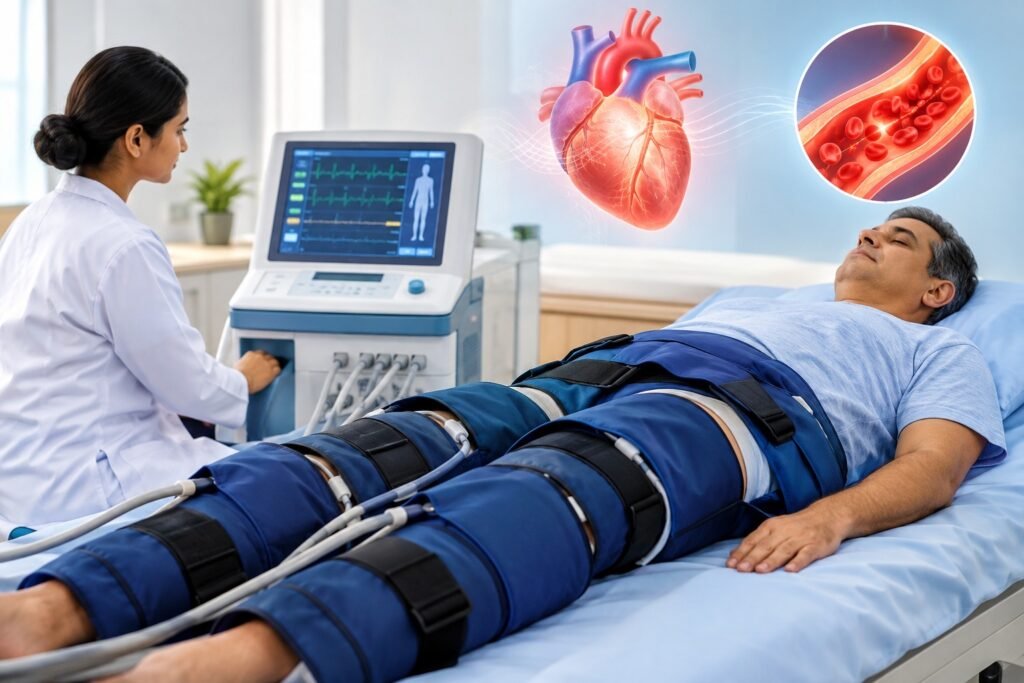
EECP uses inflatable cuffs wrapped around the patient’s calves, thighs, and lower hips. The application requires the sequential inflation and deflation of these cuffs in a particular sequence, which is coordinated with the heartbeat.
The pressure applied by the inflated cuffs helps to push blood in the major arteries upward, while also reducing the pressure in the lower body. This, in turn, lowers the workload on the heart, thus helping it to pump more efficiently. After several therapy sessions, this form of therapy promotes collateral vessel growth and enhances the function of smaller blood vessels. As a result, EECP helps promote blood circulation and reduces the strain on the heart.
3. The Role of EECP in Angina Management
The treatment of choice for patients who are suffering from chronic stable angina may have the option of receiving EECP therapy as a part of their treatment plan for managing their condition. Patients who are considering the alternative angina treatment in Kochi may want to consult with one of the area’s cardiologists to determine whether this innovative procedure is a right choice for them.
EECP treatment effectively increases blood flow to the heart. Unlike surgery, there is no cutting or implanting of stents or catheters as treatment. Patients are placed under observation throughout the treatment process, which is monitored and controlled by the beat of the patient’s heart.
However, patients should not think of this therapy as a substitute for medications or other treatments recommended by their cardiologist. The type of care provided and course of treatment recommended depends on individual circumstances.
4. Potential Benefits of EECP
The potential benefits of EECP are individualized. For appropriate candidates, therapy may offer:
- Decreased frequency of angina symptoms
- Decreased severity of angina symptoms
- Increased exercise tolerance
- Enhanced ability to perform daily activity
- Improved coronary blood flow
- Noninvasive management strategy
- Increased functional capacity
The goal of therapy is to improve patient function and quality of life by reducing the debilitating impact of chronic anginal symptoms. The cardiologist can further elaborate on potential clinical benefits based on the individual cardiac needs of the patient.
5. What to Expect During an EECP Session
The patient is placed on a special bed where lower body cuffs are strapped to the legs. Electrodes are then placed to measure your heart rate and to open and close the lower body cuffs.
The patient is awake during the treatment, which is not invasive since it is done on the outside of the body. Also, the patient will feel pressure from the lower body cuffs.
There is no exact number of sessions recommended for the treatment. It depends on the physician and the course of treatment.
However, it should be noted that the treatment works by sequentially inflating inflatable cuffs wrapped around the lower extremities, including the calves, thighs, and lower buttocks. The patient will feel some pressure on the cuffs during the treatment, but it is closely monitored and controlled throughout the procedure.
6. Supporting Heart Health Alongside Treatment
Treatment of angina usually requires not only management of its manifestations but also comprehensive measures aimed at reducing the risks of cardiovascular disease progression.
The person must adhere to the therapy and regular cardiac check-ups. Moreover, to improve the functioning of the cardiovascular system, it is necessary to make changes in everyday life, such as following a heart-healthy diet, doing regular exercises, giving up smoking, reducing stress levels and maintaining an optimal weight.
It is also critical to reduce the risks of accompanying conditions, such as hypertension, diabetes, and hyperlipidemia.
Those who are considering the EECP therapy for heart as an option for improving the state of their heart should consult with a cardiologist to get professional advice about the indications and efficiency of this procedure
7. Conclusion
The EECP therapy is deemed to be minimally invasive, making it an appropriate form of treatment for patients with chronic stable angina who wish to enhance the quality of their life and functionality. The procedure involves applying pressure to particular points on the body in order to improve blood circulation. This technology can be incorporated into a comprehensive care plan for patients with chronic stable angina. Nevertheless, it is not recommended as a substitute for emergency procedures or medications by the appropriate physician.
Therefore, prior to undergoing the EECP therapy, a patient needs to consult with a healthcare professional in order to receive the necessary intervention and develop an appropriate care plan. It may be concluded that this form of treatment, in combination with the recommendations of a healthcare professional, can become an essential step toward better heart health for patients with chronic stable angina.
FAQ
EECP is indeed completely non-invasive; special inflatable cuffs are placed on the legs and there is no need for incisions or catheterization.
EECP is not a cure for coronary artery disease and it cannot be considered a permanent fix for angina pectoris; however, it can be beneficial to eligible patients.
EECP therapy is usually a multiple-session therapy, which is spread throughout several weeks, and the timing is decided by the physician.
Eligibility for EECP therapy depends on the severity and prevalence of the symptoms, as well as the overall medical history of the patient, and is decided on a one-on-one basis after a thorough examination.
No, they cannot. Patients are advised that EECP therapy should be seen as a part of their regular treatment, meaning that all other prescriptions should be taken as the doctor prescribed.
New, severe, worsening, or persistent chest pain, especially with shortness of breath, sweating, nausea, fainting, or pain spreading to the arm, jaw, neck, or back, requires immediate medical attention.